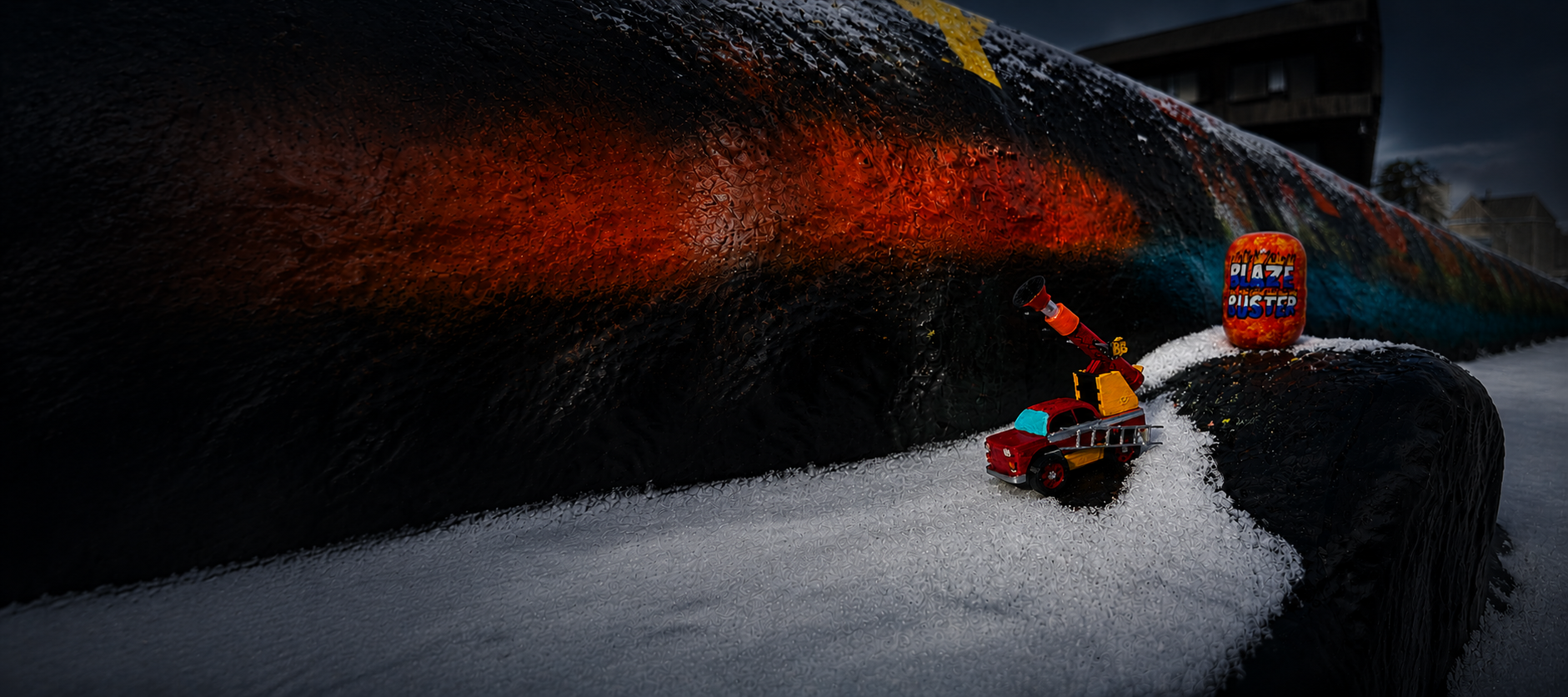
Project Overview
The Blaze Buster was a firefighting-themed mechanical toy developed as part of a multidisciplinary engineering design project at the University of Guelph. The challenge was to create a fully functional Kinder Surprise toy that demonstrated a real mechanical engineering principle while remaining safe, manufacturable, engaging, and appealing to children, all while satisfying strict requirements related to size, performance, and user experience.
As a project leader, I led the development of the toy from concept to prototype, taking primary responsibility for the design and engineering of the spring-powered launching mechanism, CAD development, technical documentation, and project coordination. Through iterative design, testing, and optimization, our team successfully developed a child-friendly and interactive toy capable of accurately striking a target over 2.5 meters away while meeting all project requirements, manufacturing constraints, and safety standards.
Design Philosophy
The Blaze Buster was designed around three core principles: imaginative play, engineering education, and manufacturability. From a user perspective, the goal was to encourage creativity through interactive storytelling. Inspired by real emergency response vehicles, the Blaze Buster allows children to step into the role of a firefighter and become the heroes of their own adventures. The mechanically engaging design transforms simple play into immersive rescue missions that encourage imagination and problem-solving.
From an engineering perspective, the toy translates classroom theory into a hands-on learning experience. The spring-powered launcher demonstrates the conversion of elastic potential energy into kinetic energy, allowing children to observe a fundamental engineering principle in action. By combining education with play, the design encourages curiosity about how mechanical systems store, transfer, and release energy.
Manufacturability was a critical driver throughout development. The toy was designed for Fused Deposition Modeling (FDM) 3D printing, with over 75% of the components optimized for additive manufacturing while maintaining structural integrity and minimizing material usage. Toolless snap-fit connections were incorporated throughout the design to eliminate the need for adhesives, simplify assembly, and recreate the classic Kinder Surprise building experience.
By balancing imaginative play, engineering education, and practical manufacturing considerations, the Blaze Buster delivers an engaging product that is both educational and production-oriented.
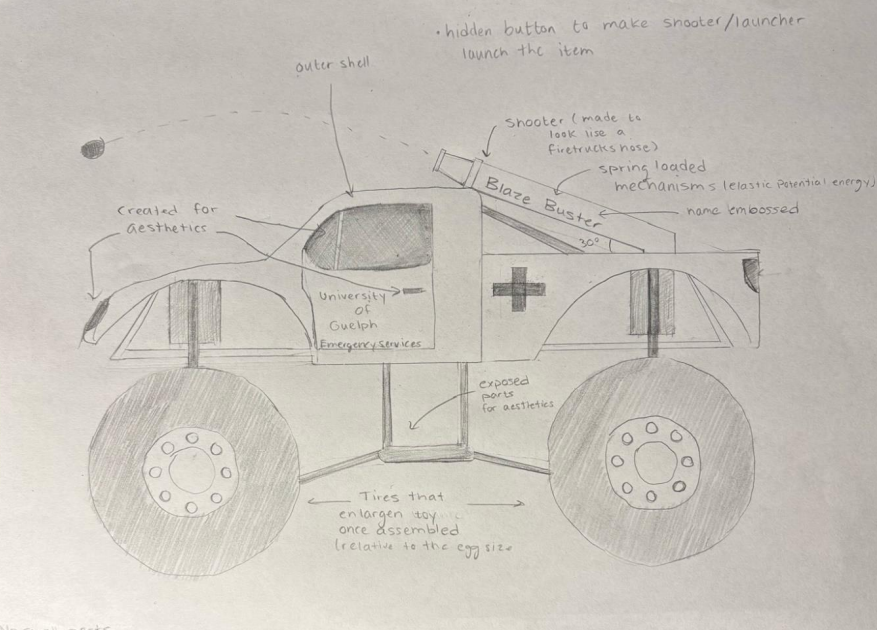
Blaze Buster Concept Design
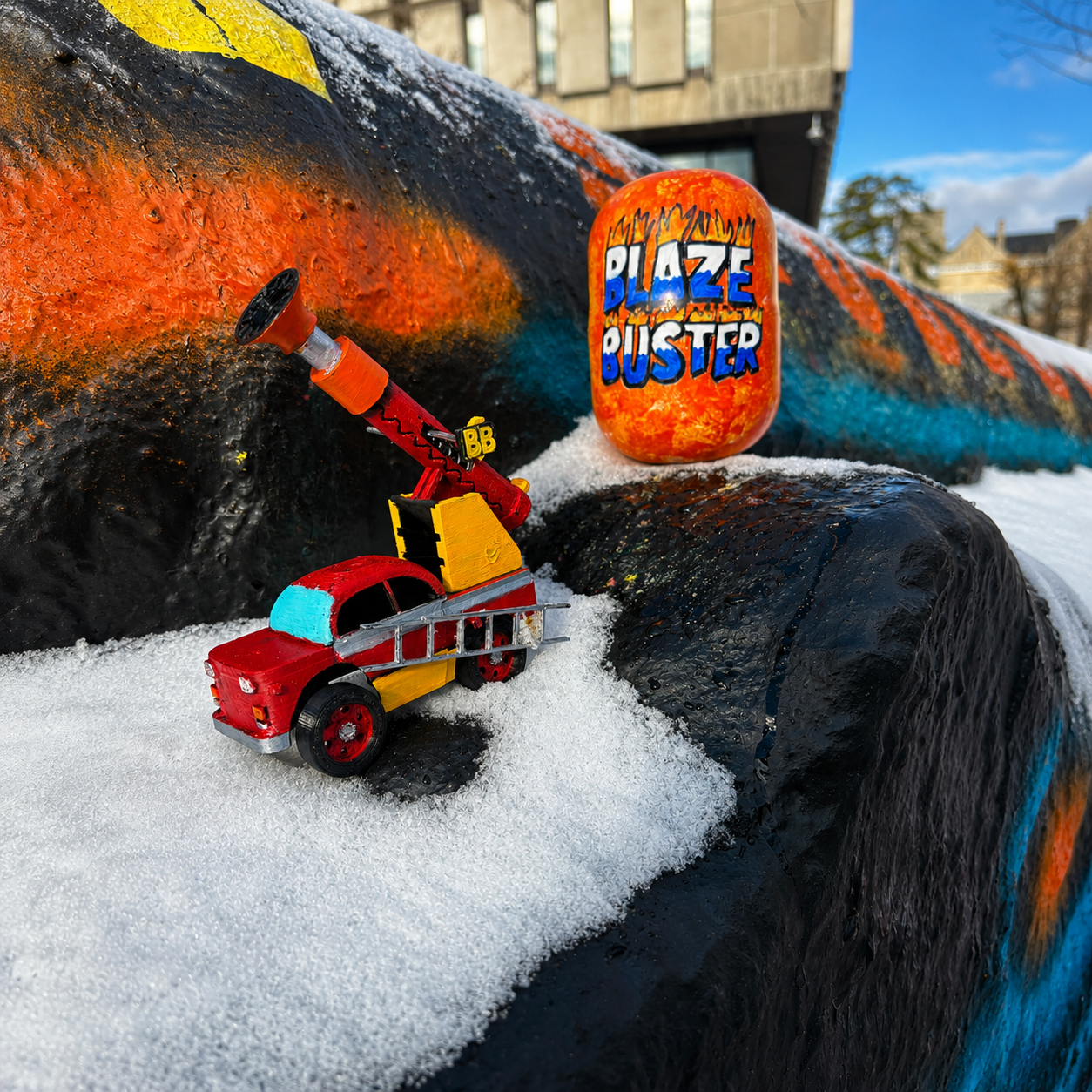
Final Product
My Role
As one of the project leaders, I was responsible for coordinating the overall development of the Blaze Buster and ensuring the team remained on schedule throughout the project lifecycle. I regularly monitored project progress, facilitated design discussions, delegated tasks, and maintained accountability to ensure all deliverables met the required engineering and quality standards.
My primary technical responsibility was the complete design and development of the spring-powered Water Cannon Mechanism, which served as the core functionality of the toy. I designed the launching system, engineered the projectile (“water dart”), and optimized the mechanism to reliably launch and accurately strike a target located over 2.5 meters away while satisfying all project constraints and safety requirements.
In addition to the launcher design, I engineered the toy’s snap-fit assembly system, applying GD&T principles and manufacturing tolerances to create secure connections that replicated the satisfying assembly experience associated with Kinder Surprise toys. I also contributed to the design and refinement of the fire truck body, ensuring the final product balanced functionality, manufacturability, and visual appeal.
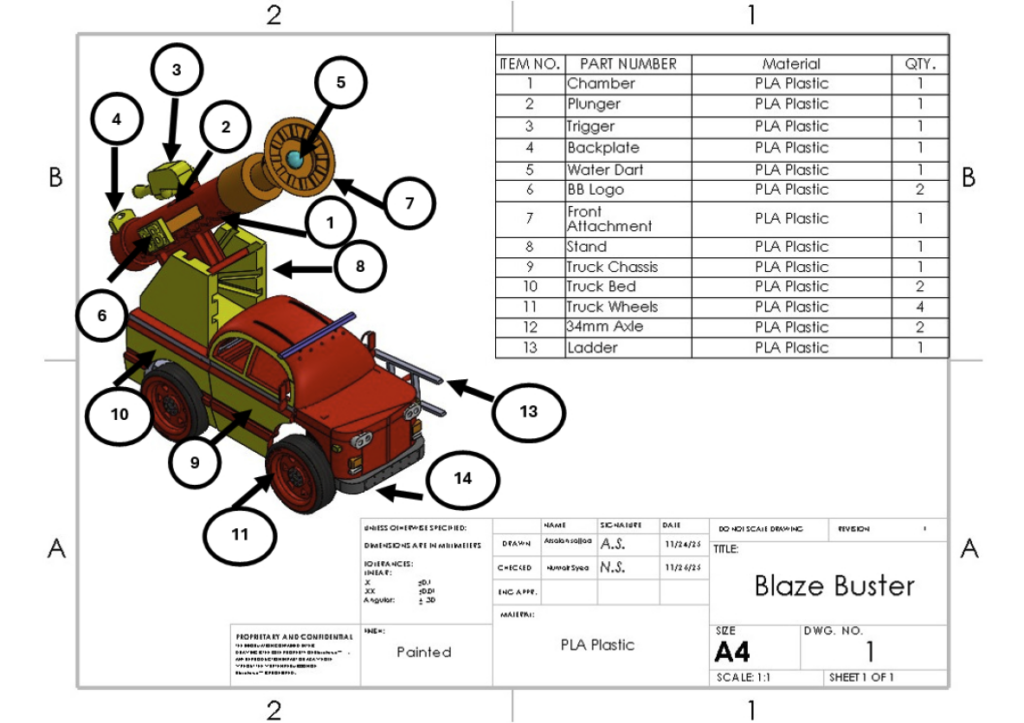
Beyond the design work, I created detailed engineering drawings and technical documentation, contributed to project reports, and developed the final design presentation. I represented the team during the project’s final proposal presentation, where we pitched the Blaze Buster to an audience consisting of professors, teaching assistants, industry guests, and children, communicating both the engineering value and market appeal of the product.
The Process
Concept Development & Design Selection
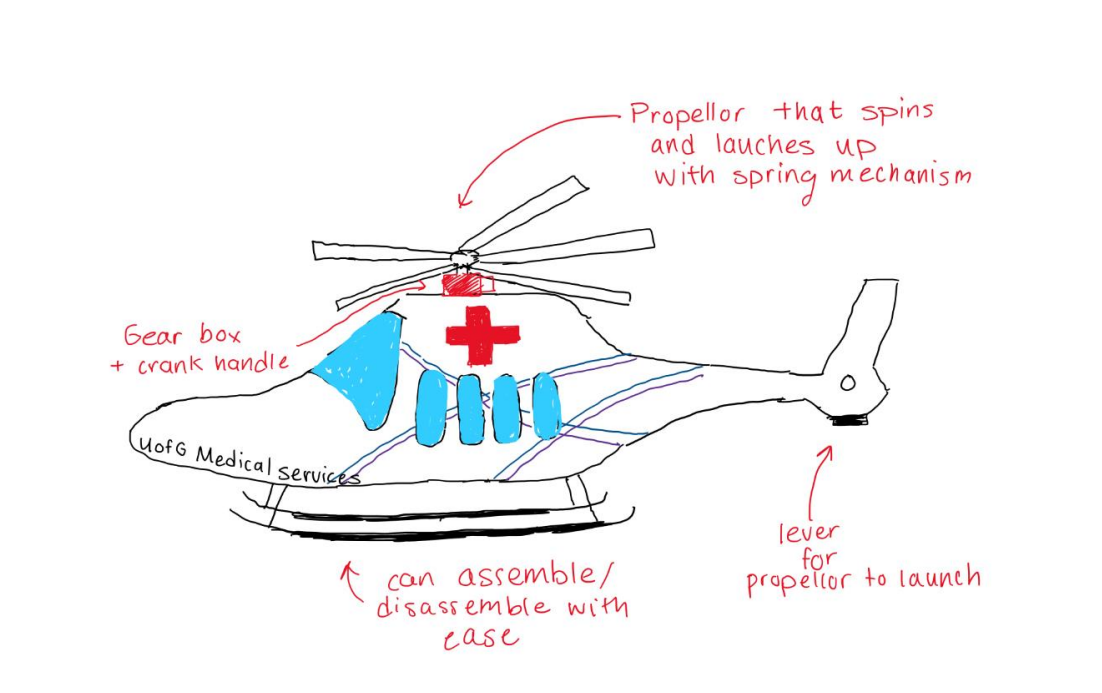
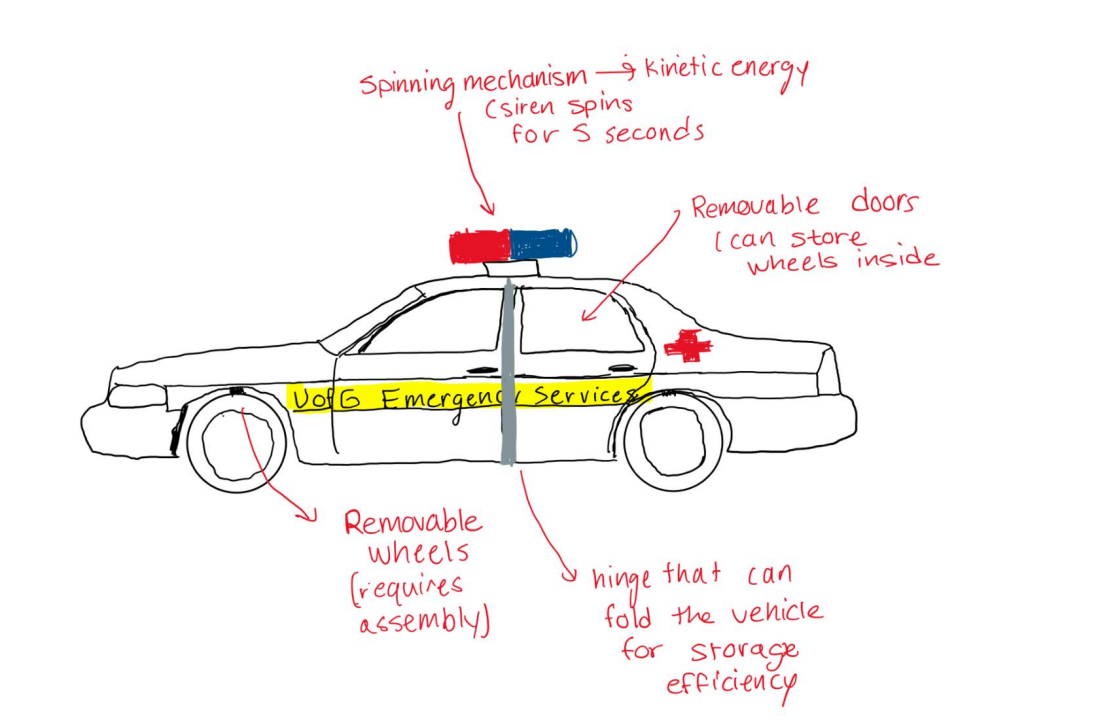
The project began by brainstorming multiple emergency-service concepts against the strict project constraints. Each idea was evaluated based on safety, play value, and mechanical feasibility. The Blaze Buster was ultimately selected because its firefighting theme offered the strongest framework to showcase mechanical energy conversion in a compact, engaging format.
Water Cannon Mechanism Development
The most significant engineering challenge of the project was developing a compact launching mechanism capable of accurately striking a target over 2.5 meters away while remaining small enough to fit within the strict dimensional constraints of a standard Kinder Surprise capsule when fully disassembled.
The design process began with the selection of an appropriate compression spring that could provide sufficient energy while fitting within the available packaging space. After evaluating several options, a 10 cm compression spring was selected as the foundation of the mechanism. Using the spring’s characteristics, I performed engineering calculations to estimate the force and energy required for the projectile to reliably travel the required distance while maintaining accuracy.
From there, I designed the complete Water Cannon Mechanism in SolidWorks, including the spring housing, trigger assembly, launcher body, and custom water-dart projectile. Multiple design iterations were developed and tested to improve energy transfer, reliability, and manufacturability while ensuring all components could be assembled without tools and fit within the Kinder capsule constraints.
A critical aspect of the design process involved optimizing spring compression and trigger geometry. Through iterative testing and refinement, the mechanism was designed to utilize approximately 80% of the spring’s available travel, maximizing the conversion of elastic potential energy into kinetic energy while maintaining safe operating loads on the surrounding 3D-printed components. The final design consistently achieved the required launch distance and became the primary functional feature of the Blaze Buster.
Trajectory Control System
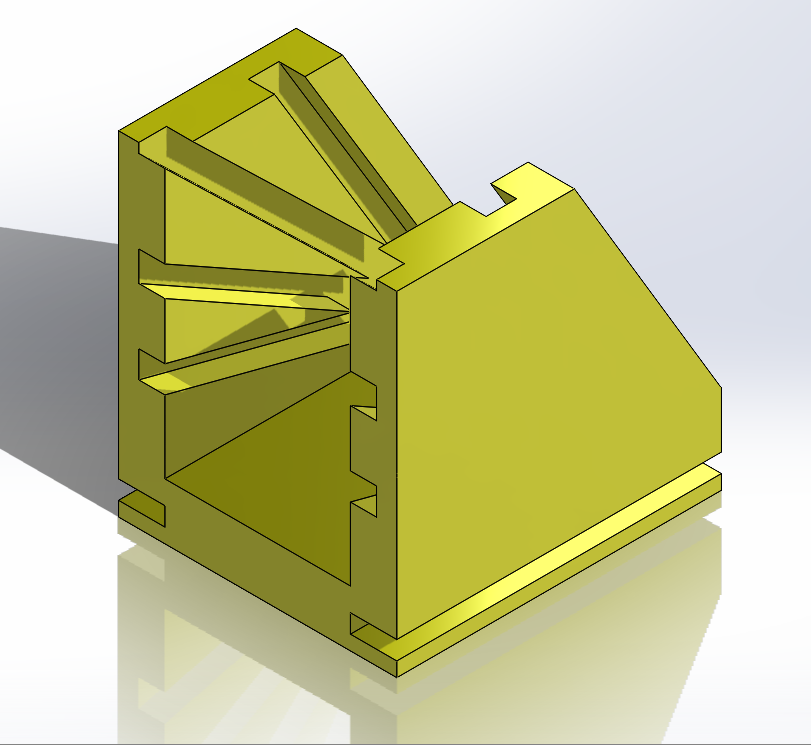
While the spring provided the energy required to launch the projectile, controlling the launch distance and accuracy presented an additional engineering challenge. Rather than creating a complex adjustable launcher mechanism, I developed a slide-in mounting system that allowed the launcher to be positioned at multiple predefined angles.
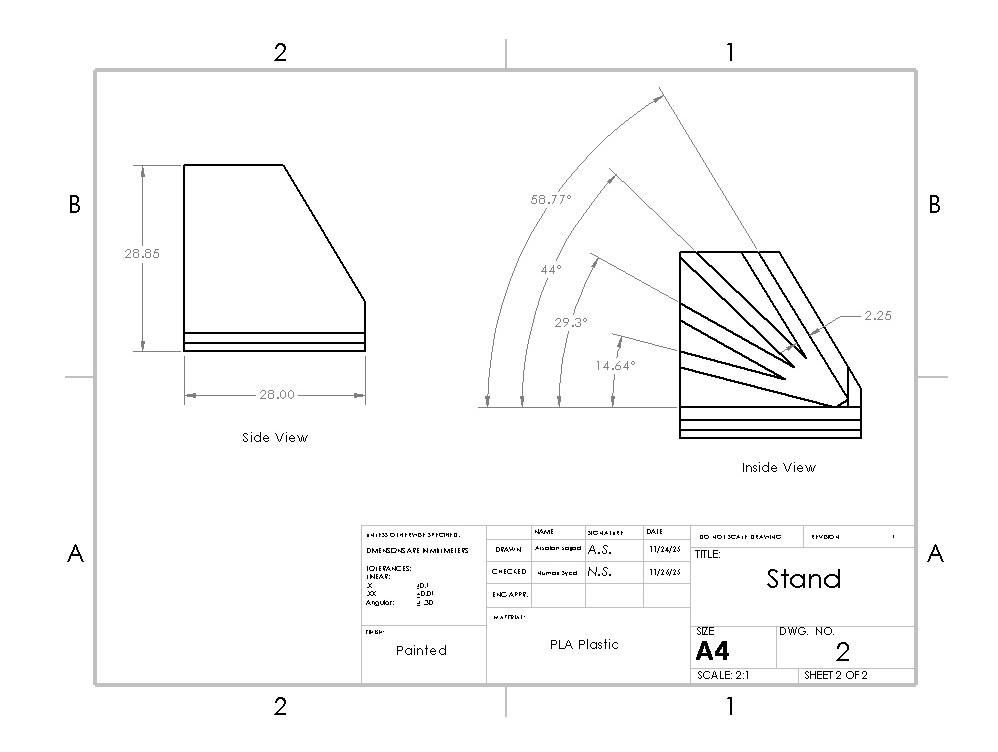
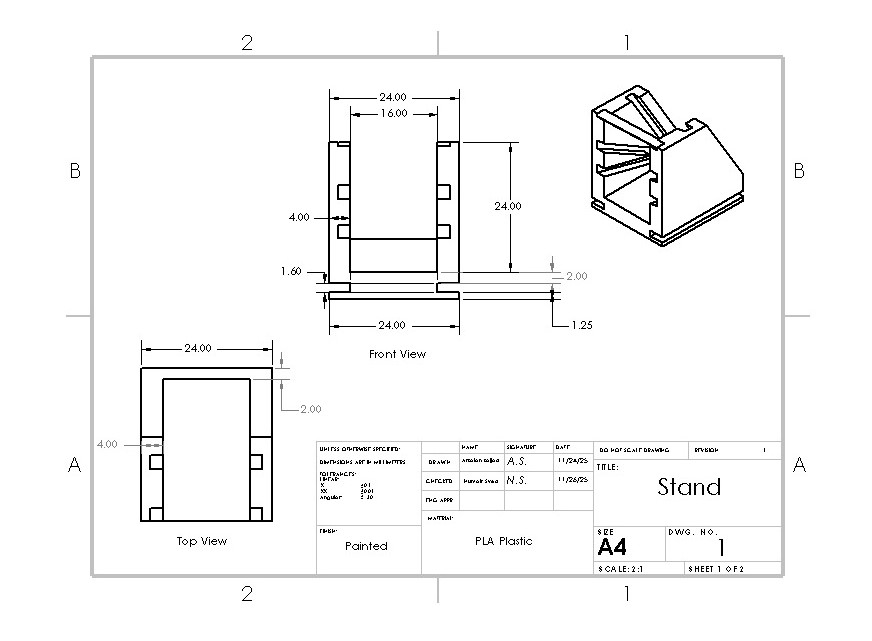
The mounting plate was designed to slide into a custom support bracket containing four launch-angle configurations: 15°, 30°, 45°, and 60°. This approach provided a simple, reliable, and child-friendly method of adjusting projectile trajectory without increasing the complexity of the toy or introducing additional failure points.
By combining optimized spring compression with selectable launch angles, the system allowed users to adjust projectile performance while maintaining repeatable and predictable results. This design balanced functionality, ease of use, manufacturability, and safety, all of which were critical requirements of the project.
Fire Truck Body & Assembly System Design
With the Water Cannon Mechanism finalized, the next challenge was designing the fire truck around it while making sure every component could fit inside a standard Kinder Surprise capsule when disassembled. Since the launcher, spring, projectile, and mounting system took up the majority of the available space, determining the overall size of the vehicle became a critical part of the design process.
I started by laying out all of the major components and determining how much space each one required. Using the dimensions of the Kinder capsule as the main design constraint, I carefully arranged the parts to maximize the available space while ensuring everything could still be packaged inside the capsule when taken apart. This approach allowed the dimensions of the fire truck to be driven by the functional components rather than simply designing the exterior first and trying to fit everything inside afterward.
Once the overall layout was established, I contributed to the design and refinement of the fire truck body, balancing appearance, manufacturability, and structural requirements. The goal was to create a toy that clearly resembled a fire truck while still providing enough room for the launcher assembly and other internal components. Maintaining realistic proportions while working within such a small packaging space required several design iterations throughout development.
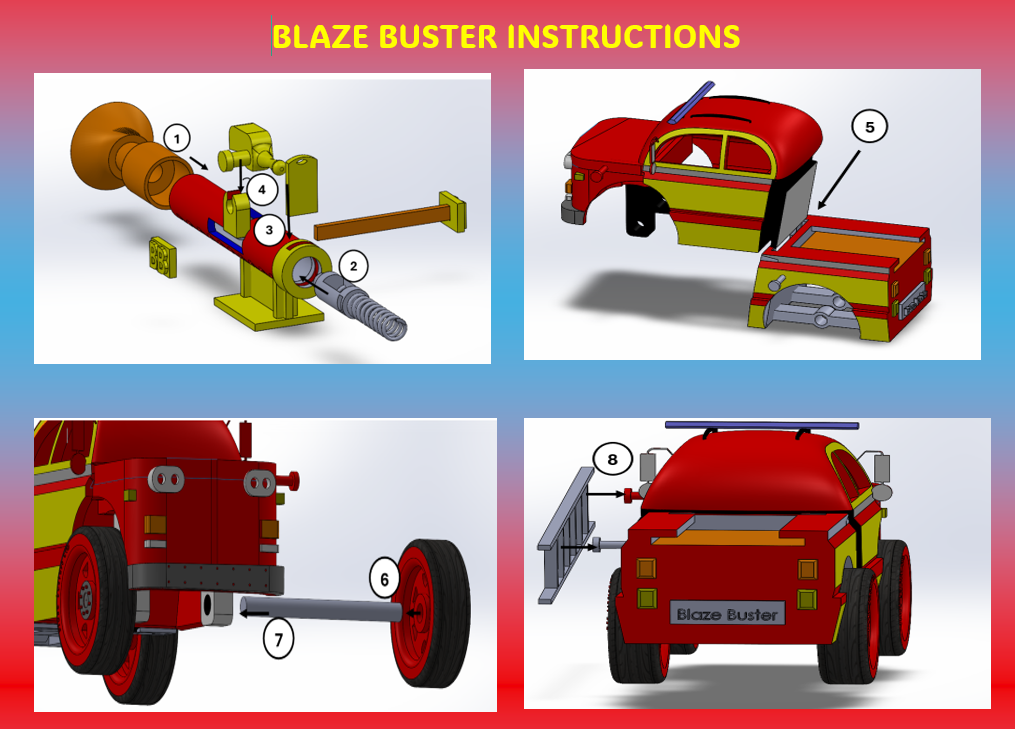
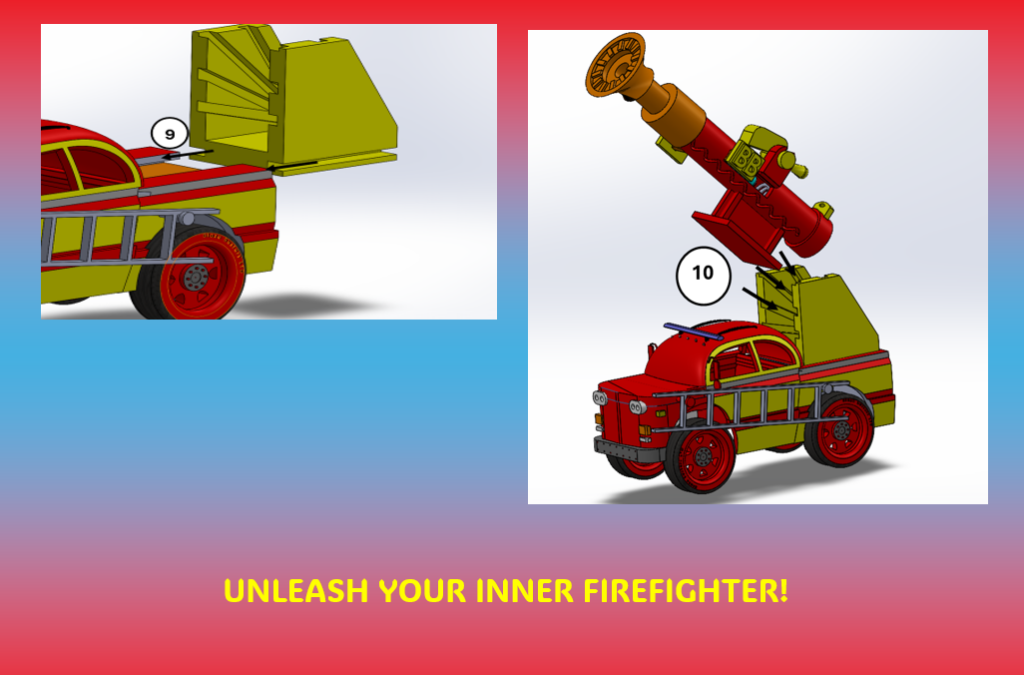
Another major focus was recreating the classic Kinder Surprise assembly experience. To accomplish this, I designed a combination of slide-fit and snap-fit connections that allowed the toy to be assembled and disassembled without the use of tools, adhesives, or external fasteners. Careful consideration was given to manufacturing tolerances and GD&T principles to ensure the connections were secure while remaining easy for children to assemble.
The final design successfully integrated all of the functional components into a compact and engaging toy that met the project’s packaging requirements while delivering the satisfying building experience associated with traditional Kinder Surprise toys.
Results
The Blaze Buster was ultimately a successful project that met all of the design requirements while delivering a fun, engaging, and educational experience for children. From the initial concept sketches to the final prototype, the project successfully balanced performance, manufacturability, safety, and user experience within the strict constraints of the Kinder Surprise design challenge.
One of the most important project requirements was accurately hitting a target located over 2.5 meters away. After multiple rounds of testing and refinement, the final Water Cannon Mechanism consistently achieved the required launch distance and successfully hit the target during evaluation, validating the design decisions made throughout development.
Safety was another critical requirement of the project. The final prototype successfully passed all safety inspections conducted by the course instructors and teaching assistants, confirming that the toy met the required child-safety standards and contained no hazardous design features.
The Blaze Buster also received very positive feedback during the final presentation and design showcase. The audience responded well to the combination of imaginative play, engineering education, and interactive gameplay, particularly the firefighting theme and spring-powered launching mechanism.
Despite the challenges encountered throughout the design process, our team successfully delivered a fully functional prototype on schedule along with all required engineering drawings, technical documentation, testing results, and presentation materials.
The project concluded with an overall grade of 90%, reflecting the success of the final design and the effort invested throughout the semester. More importantly, the project gave me valuable experience in CAD design, working within strict design constraints, technical documentation, prototyping, testing, and leading a multidisciplinary team. It also challenged me to think outside the box, solve complex design problems, and turn engineering principles into a product that was both functional and engaging for users.